
University of Washington Mechanical Engineering Industry Capstone (Winter-Spring 2027)
| Program Overview | ||
|---|---|---|
| Program Title | University of Washington Mechanical Engineering Industry Capstone (Winter-Spring 2027) | |
| Organization | University of Washington | |
| # of Students Enrolled |
0
|
|
| # of Projects Running |
0 Project/s Added (of 25 Projects Expected)
|
|
|
Program Timeline Project Duration |
Start Date: 01/04/27 End Date: 06/11/27 5 months |
|
| Collaboration Overview | ||
|---|---|---|
| About Students |
Students participating in this program are senior-level undergraduate engineering students at the University of Washington, primarily studying Mechanical Engineering and approaching completion of their degree. Senior design is a centerpiece of the professional component of UW's Mechanical Engineering curriculum, and every ME 495 capstone project is completed by a team of 3–5 students with guidance from a faculty adviser. Students bring significant preparation in engineering science, quantitative analysis, mechanical systems, design, experimentation, and technical problem-solving. Before beginning their industry project, students receive structured preparation in engineering design methodology and professional practice. During the capstone, teams work more independently while receiving regular faculty mentorship and feedback from their industry partner. Depending on the project and team composition, students may apply computer-aided design, engineering analysis, numerical modeling and simulation, prototyping and fabrication, instrumentation, controls, mechatronics, programming, experimentation, manufacturing methods, data acquisition, and testing. Students are also developing the professional competencies expected of practicing engineers, including teamwork, project management, technical communication, documentation, stakeholder engagement, and incorporating feedback into an evolving engineering solution.
Student Level: Bachelor Degree Student Time Commitment: Full Time Team Structure: 3 - 6 |
|
| Program Goals | Through the Industry Capstone experience, students will:
UW specifically describes the capstone as a rigorous full-cycle design experience involving problem definition, benchmark studies, concept generation, feasibility analysis, engineering design analysis, fabrication, and testing. Final reports also address risk and liability, ethical issues, societal and environmental impacts, and engineering economics.
|
|
| Format Structure |
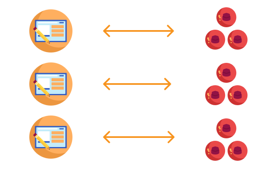
Multiple Projects Multiple Teams |
|
| Format Title | Mechanical Engineering Industry Capstone Design | |
| Format Description | The University of Washington Mechanical Engineering Industry Capstone Design Program connects organizations with teams of senior engineering students to tackle authentic, open-ended engineering design challenges. Industry partners bring forward meaningful technical needs or opportunities, while student teams apply engineering fundamentals, creativity, and a structured design process to develop and validate potential solutions. Teams of 3–5 students work on their assigned challenge across UW's winter and spring academic quarters, contributing approximately 600–1,000+ aggregate student-hours to the engagement. Students enter the project phase after structured preparation in engineering design and professional practice and then work semi-independently with regular faculty guidance and industry mentor interaction. Projects are expected to involve genuine engineering design rather than narrowly prescribed research or fabrication tasks. Students may define requirements and constraints, conduct benchmark and feasibility studies, generate concepts, perform quantitative engineering analyses and simulations, design and fabricate prototypes, develop experimental approaches, test performance, evaluate trade-offs, and iterate toward a validated solution. UW describes its capstones as full-cycle design experiences progressing through problem definition, benchmarking, concept generation and feasibility, engineering design analysis, and prototype fabrication and testing. Strong challenges might involve product or system redesign, new mechanisms, custom hardware, robotics, mechatronics, controls, test equipment, fixtures and tooling, energy systems, technology demonstrators, manufacturing improvements, or other engineering opportunities where multiple potential solutions exist. Physical prototypes are common but are not required when another validated engineering outcome is more appropriate. For participating organizations, the program provides substantial additional engineering capacity, fresh technical perspectives, access to UW talent, and a structured opportunity to investigate valuable—but not mission-critical—engineering challenges. Industry-sponsored projects culminate in professional engineering documentation and project-specific outputs, with students showcasing their work through posters, prototypes, exhibits, demonstrations, and presentations at the conclusion of the academic year.
|
|
| Benefits For Industry Partners | Participating organizations gain access to a substantial engineering collaboration while helping prepare the next generation of engineering professionals.
Additional Engineering Capacity A team of 3–5 students contributes approximately 600–1,000+ aggregate student-hours, creating meaningful capacity to explore an engineering opportunity that internal teams may not otherwise have the time or resources to pursue.
Fresh Technical Perspective Students bring new ideas, current engineering methods, interdisciplinary perspectives, and an outside view of longstanding technical challenges. UW positions creative problem-solving and fresh perspectives as central benefits of industry sponsorship.
Full-Cycle Engineering Exploration Rather than simply conducting research, teams can move from problem definition through analysis, design, prototyping, testing, and validation, providing partners with a deeper exploration of promising concepts.
Tangible Project Outcomes Depending on project needs, teams may produce prototypes, mechanisms, test rigs, engineering models, CAD packages, validated concepts, performance analyses, test results, technical documentation, recommendations, or technology demonstrations.
Access to Emerging Engineering Talent Sponsors collaborate with senior engineering students for an extended period, providing an opportunity to observe technical ability, communication, initiative, teamwork, and problem-solving before students enter the workforce. UW specifically identifies student assessment and recruiting as a sponsor benefit.
Mentorship and Professional Development Industry technical mentors help develop future engineers while strengthening their own coaching, leadership, and communication skills.
Connection to the UW Engineering Community
Participation creates a meaningful relationship with the University of Washington College of Engineering and increases organizational visibility among students, faculty, and emerging engineering talent. |
|
| Project Modality | Fully Remote | |
| Industry Partner Requirements to Participate | ||
|---|---|---|
| Project Topics | Innovation Mechanical Engineering Operations Product Design & Development Quality Control Research & Development Software Design & Development Technology Commercialization | |
| Target Industries | Aerospace & Defense Agriculture & Farming Arts & Recreation Biotech & Pharmaceuticals Computers & Hardware Construction, Repair & Maitenance Consulting & Professional Services Consumer Products & Services Education & Ed-Tech Energy & Utilities Fashion & Apparel Finance & Investment Food & Beverage Government Health Care & Life Sciences Insurance Manufacturing & Industrial Media, Publishing & Content Natural Resources Non-Profit & Social Impact Public Works Real Estate Restaurants, Bars & Food Services Retail & E-Commerce Semiconductor Software, AI & Data Sports & Entertainment Sustainability & Climate Telecommunications Transportation & Logistics Travel & Tourism | |
| Skills & Expertise | 3D CAD Modeling 3D Printing Actuator Design Analytical Modeling ANSYS Arduino AutoCAD CAD / Computer-Aided Design CNC Machining COMSOL Multiphysics Concept Development Concept Generation Control Systems Cost Estimation Data Acquisition Design for Assembly (DFA) Design for Cost Design for Manufacturing (DFM) Design for Performance Design for Sustainability Electrical Integration Embedded Systems Engineering Analysis Engineering Design Engineering Documentation Engineering Drawing Engineering Economics Engineering Ethics Engineering Standards Experimental Design Fabrication Failure Mode & Effects Analysis (FMEA) Feasibility Analysis Finite Element Analysis (FEA) Fluid Dynamics Fluid Mechanics Functional Requirements Definition Fusion 360 Geometric Dimensioning & Tolerancing (GD&T) Heat Transfer HVAC Systems Hydraulics Injection Molding Kinematics & Dynamics LabVIEW Life Cycle Assessment (LCA) Machine Design Manufacturing Processes Material Selection MATLAB Mechanical Design Mechanism Design Mechatronics Motion Control Numerical Modeling Numerical Simulation Pneumatics Product Development Product Lifecycle Management Prototype Development Prototyping Rapid Prototyping Requirements Engineering Risk Analysis Robotics Root Cause Analysis Safety Engineering Sensors & Instrumentation Signal Processing Simulink SolidWorks Statistical Analysis System Design Systems Engineering Technical Presentations Technical Writing Testing & Validation Thermal Systems Design Thermodynamics Tolerance Stack-Up Analysis Trade-Space Analysis Troubleshooting User-Centered Design | |
| Location Information & Preferences |
Seattle, WA, USA Located Anywhere Industry partners may be located anywhere, provided they can collaborate effectively with students throughout the project and provide timely access to relevant information, materials, equipment, systems, or technical stakeholders.
Seattle-area and Pacific Northwest organizations are especially encouraged when projects would benefit from facility tours, site observations, physical equipment access, prototype installation, specialized testing, or other in-person interaction. Remote and nationally located partners are strongly encouraged to participate when their projects can be effectively supported through virtual mentorship and appropriate shipment or remote access to necessary project resources.
|
|
| Sponsorship |
Sponsorship Requested (Mandatory):Pre-Revenue Startup an exact contribution amount of $18000.0 Growth Startup an exact contribution amount of $18000.0 Small to Medium Business an exact contribution amount of $18000.0 Large Enterprise an exact contribution amount of $18000.0 Government Organization an exact contribution amount of $18000.0 Non-Profit an exact contribution amount of $18000.0 |
|
| Compensation |
No Compensation Required |
|
| Other Requirements | Strong projects should present an authentic, open-ended engineering design challenge with meaningful technical uncertainty, real constraints, measurable performance criteria, and sufficient complexity for a team of senior engineers to explore multiple potential solutions. Participating Industry Partners should be prepared to:
UW recommends projects that are scoped for small student teams, include design and performance criteria, contain both design and results phases, address lower-priority rather than mission-critical organizational challenges, and are appropriate for early-career engineers. UW also strongly encourages projects that are open to students regardless of citizenship.
|
|
| Expected Time Commitment For Project Managers | 1 Hour per week | |
| Key Program Dates | Due Date |
|---|---|
|
Interview
Educators will begin interviewing interested Industry Partners to discuss project ideas.
|
Aug 17 2026, 04:02 PM UTC |
|
Request for Proposal published
Collaboration request published. Industry Partners may express interest in participating.
|
Aug 17 2026, 04:02 PM UTC |
|
Deadline to Express Interest
Industry partners learn more about the engagement
|
Sep 30 2026, 04:02 PM UTC |
|
Finalize Project Details
Final date for Industry Partners to express interest in participating.
|
Oct 16 2026, 04:02 PM UTC |
|
Official Program Launch
We’ll find a time on this day for you to meet with the students to kick off your project.
|
Jan 04 2027 |
|
Official Program End
We’ll find a time on this day for you to meet with the students to wrap up your project.
|
Jun 11 2027 |
Program Timeline
|
Due Date
|
Activities |
Deliverables
|
Status
|
Action | |
|---|---|---|---|---|---|
|
Mon, 01/04/27
|
Program Kickoff
|
No Deliverables
No deliverables are required for this action item.
|
|||
|
Location:
|
|||||
Projects
| Project | Organization | Topics |
|---|
Program Managers
| Name | Organization |
|---|---|
| Eli Patten | University of Washington |
Teams
| Team Name | Project Name | Team Members |
|---|---|---|
| No Teams Available |